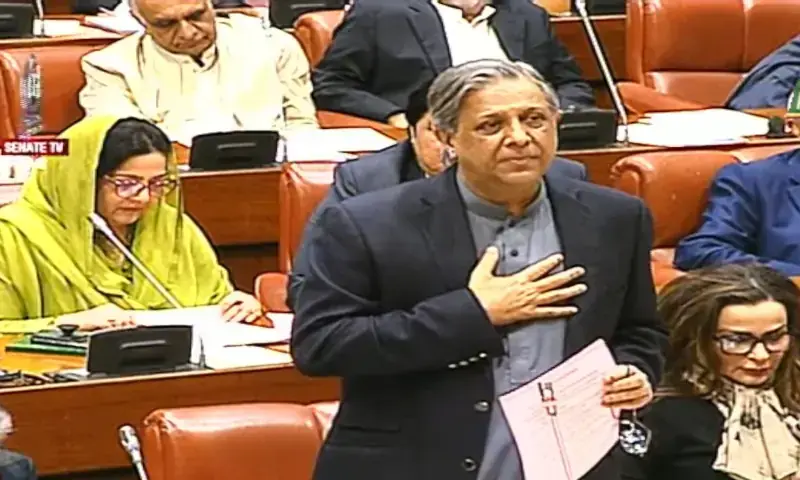
After being passed by the Senate, the controversial 27th Constitutional Amendment Bill is likely to be presented in the National Assembly today. The Assembly session is scheduled to begin at 11 a.m., where Law Minister Azam Nazir Tarar will move a motion to take up and approve the bill.
The ruling coalition succeeded in getting the bill passed in the Senate on Monday with a two-thirds majority, after receiving the unexpected support of two opposition senators, which led to strong protests from the opposition. Out of 96 members, 64 voted in favour, after which Senate Chairman Yousaf Raza Gillani announced the bill’s approval.
During the Senate session, opposition parties — Pakistan Tehreek-e-Insaf (PTI) and Jamiat Ulema-e-Islam-Fazl (JUI-F) — strongly protested, chanted slogans, and tore up copies of the bill. When Chairman Gillani began clause-by-clause voting, opposition senators gathered in front of the dais, threw papers toward the Law Minister, and continued shouting slogans. The sergeants-at-arms had to form a human shield to protect the minister. Afterward, opposition senators walked out, allowing the government to complete the proceedings smoothly.
PTI Senator Saifullah Abro, who voted against his party’s line, resigned on the spot, saying he had voted “only for General Asim Munir.” Meanwhile, JUI-F expelled Senator Ahmad Khan for voting against party instructions.
During the session, PPP Senator Farooq H. Naek presented the final committee report and explained the main changes included in the bill:
- Federal Constitutional Court (FCC): The court will have equal representation from all provinces. The required High Court experience for judges has been reduced from seven years to five. If a sitting Supreme Court judge is appointed, their seniority will remain unchanged. For newly appointed lawyers or High Court judges, seniority will count from the date they assume office.
- Suo Motu Powers: Judges will retain suo motu powers, but these can only be used when a formal petition is filed. The FCC will first decide whether the petition is valid and necessary.
- Interim Injunctions: Under Article 199, interim injunctions in revenue-related cases will now automatically expire after one year if the case remains undecided, to help reduce the growing backlog of pending cases.
- Transfer of Judges: If a judge refuses a transfer, they will be given a chance to explain their reasons before the Judicial Commission of Pakistan (JCP). If the JCP finds those reasons unsatisfactory, the judge will have to retire.
- Lifetime Immunity: The President will have lifetime immunity from criminal prosecution or arrest under Article 248, as long as they do not hold any public office after their term ends. If they take up a public position, the immunity will be suspended, but it will be restored once they leave office. Through an amendment to Article 243, this immunity has also been extended to top military ranks, including the Field Marshal, Marshal of the Air Force, and Admiral of the Navy.