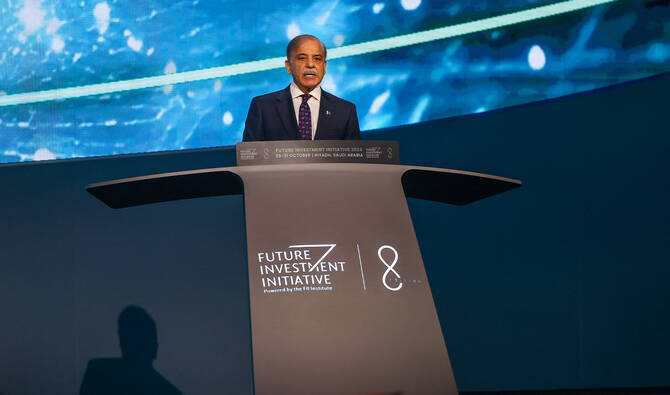
Prime Minister Shehbaz Sharif on Tuesday rejected the idea of using loans as a tool for economic recovery and instead called for mutual cooperation to support countries like Pakistan that are affected by climate-related disasters.
Speaking at a high-level roundtable session during the 9th Future Investment Initiative (FII) Conference 2025 in Riyadh, the Prime Minister said that repeated borrowing would only weaken struggling economies and eventually halt their growth.
He emphasized that if humanity wants to progress, it must move forward through consensus and collective action — by sharing both blessings and grievances — and by providing modern technologies to developing countries so they can boost productivity in key sectors such as agriculture, industry, and employment.
Pakistan and Saudi Arabia Launch New Economic Framework
The Prime Minister’s remarks came shortly after Pakistan and Saudi Arabia launched a new Economic Cooperation Framework, designed to strengthen their shared economic interests.
According to the Foreign Office, this major initiative was finalized on Monday during a meeting between Prime Minister Shehbaz Sharif and Saudi Crown Prince Mohammed bin Salman.
A joint statement said the framework aims to enhance collaboration in economic, trade, investment, and development sectors through a range of strategic and high-impact projects. It also seeks to increase the role of the private sector and expand bilateral trade between the two countries.
Priority areas under this new framework include energy, industry, mining, information technology, tourism, agriculture, and food security.
Islamabad and Riyadh are also exploring joint energy projects, including an electricity interconnection plan and several memorandums of understanding (MoUs) to boost cooperation in the energy sector.
Information Minister Attaullah Tarar welcomed the agreement, calling it “another historic chapter in Pakistan–Saudi relations” and describing it as a “milestone in partnership for trade, energy, and investment.”
Prime Minister’s Address and Reform Agenda
During the FII roundtable discussion, Prime Minister Shehbaz Sharif acknowledged that Pakistan is a resource-rich country, but admitted that “serious and honest mistakes have been made in the past.”
He said the key is to learn from those mistakes, adding, “That’s exactly what we are doing now.”
Citing the digitalization of the Federal Board of Revenue (FBR) as an example of ongoing reforms, he said that Pakistan is currently undergoing strong and much-needed structural changes aimed at tackling corruption and improving governance.
Expressing deep concern about the impact of climate change, the Prime Minister noted that Pakistan is among the world’s most affected countries, despite contributing “less than a fraction of one percent” to global carbon emissions.
He said Pakistan continues to suffer from repeated cycles of progress and setbacks due to climate disasters such as the floods of 2022 and 2025, which he called “unacceptable.”
He urged the Global North and Global South to agree on a fair distribution of resources and work together for a more equitable global economy.
The Prime Minister added that Pakistan is rapidly embracing technology and artificial intelligence (AI) to accelerate development, though he also warned of the potential risks associated with AI.